Translate

Thursday, August 22, 2013

Our Days Off


Note: I finally have my personal laptop! Previously, I was trying to blog from my fema laptop, which was a horrible, awful, stupid piece of junk. This had been written for awhile, and I'd been unable to post it, but here it is, complete with pictures and everything! Enjoy.


After my last post about data entry, I’m sure you’re thinking, “Days off? Why would they want days off? Data entry and property inspections are probably the most fun thing there is to do in New York anyway.”

You’re right. Unfortunately, the man says we can’t come in Saturday and Sunday, and so we don’t. So let’s see if I can remember all the excruciatingly boring things we’ve done on the weekends since we got here. 

Our first weekend here...


….a few of us went into the city with our teammate, who’s from the Bronx and had a doctor’s appointment there. We ended up getting to meet her mom and brother, too, which was awesome. I like meeting my teammates’ families ( I met my other teammate’s mom and sister who live in Queens, and am going to Massachusetts to another teammate’s house this weekend and will get to meet her fam). It explains so much, while raising so many new questions. We also tend to get in a rut where the only thing we know about our teammate is their AmeriLife and we have a vague idea of what they were before that, but really not a lot. Meeting their family gives a little bit of insight.

After her appointment we took the train down into Manhattan and wandered around a bit. We made a stop at the Museum of the American Indian, and then checked out a street fair that was going on outside of it. We decided to walk around and find a cheap bar to hang out in while we were waiting. Since “cheap” and “Manhattan” don’t usually show up in the same sentence, this was difficult. As we were walking around, we stumbled upon Les Halles. Having read Kitchen Confidential last year, I recognized it as the restaurant where Anthony Bourdain used to work. Seeing as how my life goal is to become Anthony Bourdain’s protégé and take over for him as a host of a TV show where I get to travel the world and eat delicious food, I was excited to have found his former employer, who probably still keeps in touch with him and could recommend me as his predecessor. Really, I just wanted a picture. But then we saw a sign out front that said “Happy Hour - $2 Shrimp, $1 Oysters, $5 Beer”. Lucky us, that sounded within our price range, so we decided to pop in. It was very swanky, and I’m sure our waitress picked right up on the fact that we were not about to drop $100 on a gourmet meal. She gave us menus, and after seeing that the apps were in the upper teens, we gave them back and said, “We’re just here for Happy Hour,” and each ordered a beer.

“You have $2 shrimp right now, right?” my teammate asked. The waitress nodded. “OK, I’ll have that.”
“And how many would you like?”
“Umm….how many comes in an order?”
“As many as you like.” The waitress saw the cogs turning as we processed what she meant. “Each shrimp is a dollar,” she confirmed.
“Oh. Hmm…..And you have $1 oysters?”
“Yes.”
“I’ve never tried oysters. I’ll take one of those.”
“Just one oyster?”
“Yes, please.”

We devoured the complimentary bread basket because all we had eaten for hours was a bagel. And then this was delivered to us:

She enjoyed her one oyster very much, and we decided to move on. I’m sure our waitress was very disappointed that we didn’t hang around.

We walked down to South Street Seaport, and it began to rain. Being of very high intelligence, we chose to sit outside on the pier. The umbrella over our table had one job, and it failed miserably. After one drink we were soaked, but decided to wait it out under the leaky umbrella instead of going out into the rain to the subway. Finally, we gave up on that and made our way back to Melville. 

On our second weekend here...

….we decided to take a tour of Brooklyn Heights with a company called Free Tours by Foot. Just like it sounds, the tours are actually free. At the end, you pay the tour guide what you think it was worth. Seeing as how we’re all broke, this seemed like a nice idea.

The tour was exactly what you’d expect to get from a tour that cost $30. Our tour guide was funny, knowledgeable and friendly, and we learned a lot about the area. Also, our tour guide loved us when he found out we were in AmeriCorps. He kept telling the Australians and Israelis on the tour about AmeriCorps and what we do and how awesome we are for volunteering our time. 

He pointed out some interesting things on the way, like the house Beyonce and Jay-Z almost moved into, subsequently driving up prices on the whole street, the house where Truman Capote used to live in the basement, and a stop on the Underground Railroad. The tour ended at the Brooklyn Bridge and we walked over the bridge and headed to Chinatown. We got some food there, then walked through Little Italy.

Our tour guide had suggested we take the free Staten Island Ferry if we wanted a nice view of the Statue of Liberty, so we did that at night. It was a really pretty ride. After that we headed back home. AmeriCorps was nice enough to provide us with a metro card that gave us unlimited rides for the month. This really helped to get around the city for free, and usually we were able to take the van into Queens where we could get on the subway, instead of taking the Long Island Railroad, which cost $6-9. 

On our third weekend here...

….a group of us came back into the city. Me and a teammate walked through Central Park and attempted to do a Harry Potter geocache in the park. However, we were not smart enough to figure out the puzzle, and after about 5 minutes, we gave up and just took a walk.

Our next stop was the Highline Park. It used to be an elevated track of the New York Central Railroad, and now it’s been converted with plants and artwork into a really beautiful elevated park. 

After a stroll there, we headed down to Brooklyn, because I found some Georgian restaurants there, and this will probably be my last chance to get authentic Georgian food for a while. It was quite a long train ride, but it was worth it.

The place was called Tbilisi Restaurant, and as soon as we walked in I felt like I was back in Georgia. My favorite Georgian song, Ramdeni Malodine was playing on the speakers, and a big table in the corner looked like they were at the tail end of a supra. We had the adjaran khachapuri, a bread in the shape of a boat, filled with cheese, egg, and butter, the eggplant rolls filled with walnut puree, mchadi, a fried corn bread patty, and khinkali, or Georgian dumplings. My friends loved it, and in true Georgian fashion, we were all completely stuffed by the end. It only came out to about $10 per person, too, which was insane for the amount of food we got. And, our waitress was awesome. She talked to me about Georgia, and after I told her where I was living, she didn’t really believe me when I said I enjoyed it… She also came over and told us we were doing it wrong when we were eating the khachapuri. Apparently I never learned how to eat the Adjaran kind correctly, so she grabbed our forks and knives and did it for us. Then she stopped over later to double check that I was showing them how to eat the khinkali the right way.

Deep in our food comas, we boarded the subway back to Queens. 

On our day off because of a gas leak in the office...

….yes that happened. Apparently there was a gas leak in the office in Woodbury where we work, so we got the day off while they took care of it. We took that time to go into Manhattan and check out the Metropolitan Museum of Modern Art. I’d been there when I came to NY in the past, and was excited to go back, because it’s one of my favorites ever. After spending a few hours there, we walked around and tried to find a cheap place to eat on 5th avenue (ha!). Then back to our good ol’ extended stay hotel.

On our fourth weekend here...

….we did team stuff. On Saturday we had an ISP (independent service project) which is AmeriCode for volunteering somewhere other than our project. We are required to do 10 hours of ISPs relating to disasters, so we signed up to work with an organization called All Hands that works with disaster survivors. We went to a woman’s home in Island Park to help her clean and gut her garage so that they could sanitize it and get rid of the mold. This woman was awesome. We were ready to get to work when we arrived, but she insisted that we come in and sit down for some bagels and coffee. After that, we started helping her clean out her garage and sort through the stuff she wanted to keep or give away. We then packed the ‘keep’ stuff into a storage unit in her garage. Once the garage was completely cleaned out, we started tearing out all the shelves, drywall and insulation. By the time we got all that done, it was about lunchtime.

We had all packed lunches, but it turns out our Italian hostess had been preparing us homemade pizzas. It was absolutely delicious. She made sausage, cheese, mushroom/eggplant/sausage, and sausage and onions in white wine sauce pizza. Upon her insistence, we sat for a long time around the table. Her Italian mother was there also. She didn’t talk much, but when she had something to say she said it. She saw my team leader eating goldfish crackers and said “Why you eat this? This is not real food! This is junk!” Later, she turned to us out of the blue and said, “You like-a the pope?” It was classic.
We went back to work after lunch, but it didn’t last long. After about an hour, her mother started sticking her head out the window saying, “Coffee’s ready! Come drink coffee!”
We went back inside and she had coffee and espresso ready for us. And blueberry pie. And apple pie. We got very spoiled. But I think we were able to get a lot done for her, and helped her move a tiny step forward in the long recovery process. 

On Sunday we did a team SLI, or Service Learning Initiative. This can be a broad spectrum of things, and this one was a community and cultural SLI. The team went together into Manhattan to visit the 9/11 Memorial. This was the first time I had seen it, and I thought it was a great tribute to those who passed away. My favorite part was the Survivor Tree, a pear tree that had survived the attacks and was then replanted in another park. After the memorial was built, they transplanted it back. 
After leaving the memorial, we visited Trinity Church, walked down Wall Street, and then headed to Chinatown for lunch. We went to a place called Wo Hop, which was recommended to us by our tour guide from the Brooklyn Heights tour we had taken. It was in that basement restaurant that I had the best Chinese food of my life, the Roasted Duck Chow Fon,  for like $6.95 or something. Amazing food seems to be a theme of my time in New York. 

On our fifth weekend here...

...a few of us joined our teammate Ana, on a trip back to her hometown of Wareham, Massachusetts. She had taken a few days off and gone home earlier, and we met her on the weekend. Unfortunately we were cursed by the bus gods, and had a terrible time getting there and back. 

We booked Megabus on the way there, and ended up missing our bus, because the employees told us to get in the wrong line. Then they told us we'd have to pay for new tickets and leave the next morning. After bombarding their tiny customer service call center, we got our tickets transferred over to the next bus to Boston, without having to pay extra. We didn't end up getting in to Boston til about 4 a.m., but luckily Ana and her mom are awesome and still came to pick us up. 

The next day we headed to the beach at Cape Cod and got to enjoy this...
Then we stopped in Plymouth to try some real New England clam chowdah. We were practically licking the bowls. We also got a chance to check out Plymouth Rock, or what they claim was Plymouth Rock. 

Then it was back to Ana's house, where her family had prepared a feast for us. Lobster, crab that her dad had caught that day, shrimp pasta, and of course s'mores around the bonfire for dessert. A great end to the day.

The next day we went into Providence where we were taking the Greyhound back to NY. We walked around Providence for a little bit - it was Sunday, so it was a bit quiet - and then we got in line for the bus. Unfortunately, when we'd made it to the front, the bus driver informed us that he had 2 seats left and 5 of us left. Thank you, Greyhound, for overbooking your bus, and leaving us on the side of the road. They sent us on another bus an hour and a half later. We then got stuck in traffic for a good 2 hours on our way through Connecticut. When we finally got back into the city, it was much later than we had anticipated, and we didn't finally get to Melville until after midnight. 

Lesson learned: most major bus companies in America suck.

-----------

And that is what we did in New York when we were not staring at computer screens. 

Tuesday, August 13, 2013

Resting Bitch Face

I learned about Resting Bitch Face from an article my dad emailed me on the topic (still not sure what he was trying to imply with that email).
As I read the email, it all sounded much too familiar. I remembered how one of my high school teachers (who may have had a case of Constant Bitch Face) would always come up to me when I was minding my own business and say “What’s wrong?”
“Nothing,” I would try to tell her, but she wouldn’t believe me. For so long I thought, “What is this woman’s problem? Jesus Crackers, just leave me alone!” But then other people started asking me what was wrong at other times when I was just chilling. After reading the email, I had to face the fact that it is me with the problem.
I have a severe case of Resting Bitch Face.
After reading the article, I told my team about it and they confirmed my fears. Even at times when I’m completely content, and just sitting there thinking, they point out to me that I’m doing RBF. I had no idea this happened so often!
Not long after this discovery, I was sitting at my desk at work, and my crew lead came up to me and asked if everything was ok.
“Yeah,” I said. “Why?”
“I don’t know, you just looked like you were not happy about being here. Did you get enough sleep last night?”
“Yeah, I’m fine. I’m not unhappy, it’s just my face. I get that a lot. I swear, that’s just my face.”
Here’s what I think the problem is. First off, I have extremely droopy lip corners. If I’m not actively making an expression with my face, they just droop like dying flowers. One side is worse than the other, so when I have to do a no-smile picture, like my FEMA badge for example, which is more awful than I can convey with words, the right side of my mouth droops way down, and I look like I’ve suffered a stroke. There’s no way I can control it. When I know I’m going to have to take one of these photos, I practice in the mirror ahead of time, trying to purse the right side of my mouth up. Somehow it makes it even more pronounced, and the picture always turns out horrible despite my best efforts.
Me trying to look normal. Notice the dead eyes and droopy crooked lips.
The second problem is my dead eyes. Again, when I’m just chilling, my eyes tend to lose all life and I look like a corpse. A corpse who died of a stroke.  When I realize I’m doing it, I attempt to open my eyes wide and focus on some kind of object so that I look alive. This may backfire too, as I recently found out, when my friend turned to me and said “Wow, you look super alert right now for some reason. What’s going on?”
Some other alternatives I’ve tried are Resting Happy Face, but that just seems to creep people out. I tried Duck Lips Face, like the girls on Instagram, but unfortunately I was born with chicken lips, and am unable to convert them to duck form. Resting Alert Face, like I said, is just awkward. When I do Resting Pensive Face, it just ends up making me look angry or confused.
In the end I can only cross my fingers and hope that people will realize I’m not actually a bitch. Or at least not as big of a bitch as my RBF makes me look.
And sadly, the bad news keeps coming. I was recently informed by a friend that I also suffer from Train Depression Face. If the name is not sufficient explanation, basically it means that when I ride a subway, I look like I’m about to off myself. People are probably concerned that I’m going to get out, run across the platform, and jump in front of the next one. So now I’m going to have to remember to think happy thoughts next time I’m on a train, and hope that some of it registers in my facial expression.
Or I could get a tattoo on my forehead that says “It’s Just My Face”.

Wednesday, July 31, 2013

Mitigation

Normally our team works in Disaster Survivor Assistance. We go door to door doing outreach, registering survivors, and doing case inquiries for those who have already registered.
Since Hurricane Sandy happened so long ago, the DSA stage of the disaster is over. The project we're working on is brand new for us. We're updating the flood database for the Hazard Mitigation Grant Program and looking at homes that have had repetitive losses. In other words, we're going to the homes who've had more than one insurance claim for flooding (ex: they got hit by Irene and then again by Sandy) and we collect data on them and enter it into the database. The purpose is to figure out which of the homes are draining the money from the National Flood Insurance Program, and find out how we can mitigate - either raising the home or buying it out and turning the land into public space, not allowing anyone to build there because of the flood risk.

As far as what I actually do.....our days consist of either field work or office work. We go out into the field to inspect houses. We drive to our assigned areas and complete worksheets on each repetitive loss house, finding out what kind of foundation and structure it is, in what neighborhood, if it's elevated, etc. We gather all of this information from the street, and only talk to homeowners when they happen to be outside, so it's a lot less face-to-face interaction than we were used to in DSA. When we don't go out into the field, we're in the office entering the data that we collected from the inspections, looking up tax records, or plotting the homes on special maps to show what flood zone they're in.

At first I wasn't too thrilled about the work, but it turns out it's not so bad. Except for the heat wave when we first got here, the weather has been so much better than it was in our previous deployments, so I''m not dripping in sweat after 5 minutes in the field. We're also working in a neighborhood on the beach, so we get to see a lot of nice houses and sailboats docked right next to them. There are about four other FEMA Corps teams here as well, so the office environment is fun, and there's tons of people to hang out with when we have free time because we're all staying in the same hotel.

And I must admit, it is kind of nice to do some office work. I'm getting to brush up on excel, that's for sure. I was ridiculously proud of myself the other day for figuring out (all by myself!) how to make a spreadsheet that would add up the team's work stats for the week instead of me doing it manually! Oh the things I get excited about these days :/

One of the problems is that the crews are behind schedule (since we got kept longer in Oklahoma than they were planning) and now we have to work 10-hour days Monday through Friday. Between that and all our AmeriCorps duties, it doesn't leave a lot of time to enjoy the Big Apple. But that doesn't stop us from squeezing in some fun when we can. I'll post soon about all our exciting escapades in NYC.

Sunday, July 28, 2013

Roadtrip!

Day 1: Denton, TX to Memphis, TN

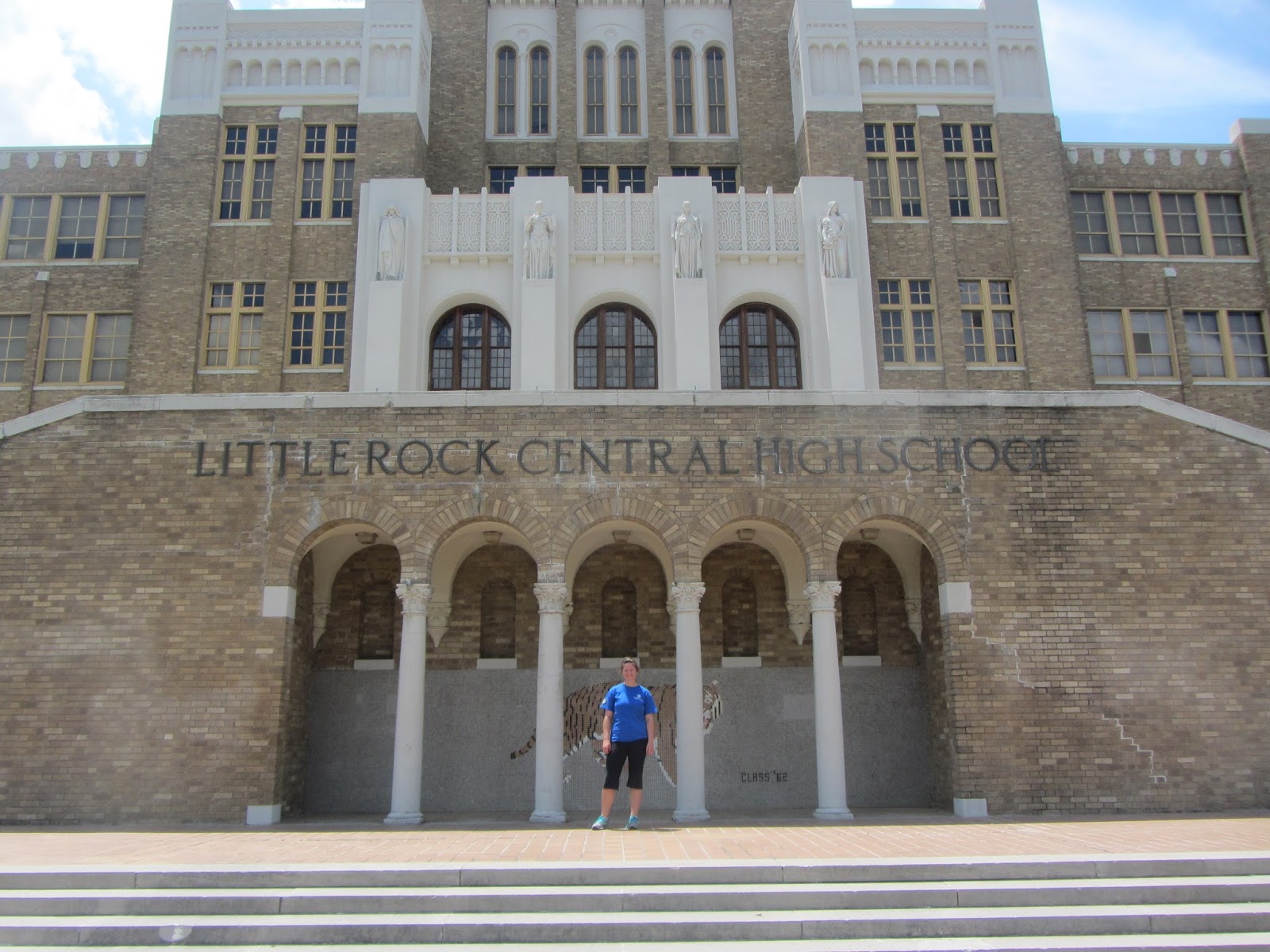
The first day of the road trip included my first time every in the state of Arkansas, and a visit to the Little Rock Central High School, known for being a centerpoint in the fight for desegregation in the South.


We arrived to Memphis in the evening and had just enough time for a team dinner at the apparently world famous Gus's Fried Chicken, before heading back to the hotel and going to bed.


I hated the idea of being in Memphis, but not visiting Graceland so I found out on the handy-dandy internet that for one hour each morning, they open up the Meditation Gardens for free, and you can visit Elvis's and his family's graves.

Day 2: Memphis, TN to Lexington, KY

Luckily my team was not opposed to getting up a bit earlier, so we were able to make it to Graceland, much to my delight. I was a little stressed, because I thought a traffic jam was going to make us miss the hour-long window of free entrance, but we made it in time, because Ana drives like a boss. It wasn't very crowded at all. There were only a few other small groups, and one guy who had Elvis tattoos on every limb.


Since we were driving through Nashville anyways, we decided to stop for a few minutes and have a look around. We saw the Ryman Auditorium, walked around the downtown area (I have no idea where we were, I just know there were lots of bars and souvenir shops), and got back on the road.


Then we rolled on into Kentucky. I was surprised to find that Kentucky looked exactly as I imagined it. Picturesque green fields with white fences and horses grazing under oak trees. Or other kinds of trees. I can't pretend like I can tell the difference. We did nothing in Lexington besides get food from Walmart and sleep, so no exciting stories there.

Day 3 - Lexington, KY to Hagerstown, MD

Probably the most uneventful leg of the trip. We stopped in West Virginia.

That's all I got.

Day 4 - Hagerstown, MD to Melville, NY

We finally made it!!

Transition

Traditional AmeriCorps NCCC divides the 10-month service term into 4-6 different rounds. Each round concentrates on working with a different organization and the rounds are separated by a transition week at the base campus. Since FEMA Corps projects depend on something as unpredictable as natural disasters, it doesn't always run so smoothly for us.

The tentative plan was for us to transition in mid-June, but becasue they needed to keep us around a little longer in Oklahoma, about half the teams transitioned at the normal time in Denver, while the other half, my team included, transitioned a few weeks later in Denton, TX. We were bummed that we wouldn't be able to see a lot of our friends, but we were excited to be back in Denton to browse Recycled Bookstore, have a po' boy at Hoochie's, and drink a beergarita at Fuzzy's Tacos just one last time. Plus, what better state to spend the 4th of July in than Texas?

We got to stay at an amazing dorm at the University of North Texas, and after my roomate left mid-week to visit her family back home, I had a giant room all to myself. I realized that it was the first time in 5 months that I had had any substantial amount of time to myself. And, since they gave us a 4-day weekend, it was the first time in over 2 months that I had had over 2 days off (we only had one 2-day weekend in OK, and that was due to weather conditions). For those of you who know me, and know how I need my time to myself on a regular basis, you may be surprised that I haven't lost my mind by now. However, I haven't really had a problem with it. I think spending 4 months in Georgia with endless amounts of free time spent with people I could only communicate with on a 2-year-old level, I'm good on 'me-time' for a while. Once my roommate was gone, I found myself pacing the room, trying to figure out what to do with myself, before finally trying to go find someone to bother.

Transition week was useful. We did team debriefs where we got to learn about the other teams' experiences and got to share ours. We got to air our issues regarding the program with the people in charge, we had career workshops, and they even took us to a Rangers game!


On our free days we hung out in the square and lounged on the beach of Lake Lewisville. It was a good time. And then, too soon, it was time to pack up. It wasn't too hard to leave though, since our next stop was....

NEW YORK CITY!!
 
Well, Long Island, but still....


Friday, July 5, 2013

Oklahoma

It’s been quite a while since I updated my blog. I never posted the whole time we were in Oklahoma, which was a little over 5 weeks.
We arrived the day after the EF-5 went through Moore, 2 days after the tornadoes ripped through Shawnee, a city nearby. The destruction that we saw that first day, and continued to see throughout our time there was mindboggling. It went from houses that looked completely fine to piles of rubble on the next block.

The first night and the next day was spent at the mobile DRC which was set up in the parking lot of the First Baptist church in Moore. A small RV city had sprung up in that parking lot, with occupants from the Red Cross, Salvation Army, faith-based organizations, animal shelters, insurance companies, and state and local officials.
The first man that I registered had lost everything. He had just retired from the military and was describing to me matter-of-factly how the tornado had flattened his home. He had recently moved and hadn’t yet had time to buy an insurance policy. All of his personal possessions that remained could now fit in his truck, and for the time being, the truck was his new home. I gave him the addresses to shelters the Red Cross had set up, but he said he didn’t want to go to a shelter. He’d be fine. He had seen this kind of destruction in Afghanistan, he told me, but it was nothing like seeing it in his own town.


How do you do door to door outreach and registrations when there is nothing left standing in the neighborhood? This is what I was wondering as we first drove through the path of the tornado.
Most of the severely damaged areas were closed off to the public in the days immediately following the disaster. There were downed power lines, debris all over the road, and large objects like limbs and parts of houses that were positioned precariously on top of each other, ready to fall. After a few days, some of that had been taken care of, and the police and national guard let us in with our badges and were letting homeowners in with proof of residency.

At the beginning of the disaster, our efforts were concentrated on the hard hit areas. That meant we would walk around the areas and speak with the people sifting through the debris and trying to salvage what they could.
The idea of this seemed terrifying to me, just to walk up to someone who was standing on a pile of broken boards and muddy objects, now unable to tell if they were standing in their bedroom or living room, and interrupt what had to be an extremely difficult and emotional problems to tell them about FEMA assistance. I was unsure how they would react, and how I would react. This was so much bigger than West. I do not want you to misconstrue that and think that I am in any way diminishing what happened to the people in West. It was a terrible tragedy and for everyone affected and everyone who lost their home or their loved ones it is something that will affect them for the rest of their lives. What I’m trying to convey is that in West, you at least had some semblance of where you were. The street signs were standing, most walls were standing, you could look around and imagine what it looked like before. In Moore, you could have been anywhere. There was nothing recognizable. It’s what you would imagine the end of the world to be like. At the beginning I couldn’t even process it. It didn’t seem real. And even after more than a month, I still can’t really wrap my head around it.

So how do you talk to people that used to call this home? To be honest, I was shocked by it. People held themselves together incredibly well. Most wanted to tell us their stories. Where they were when it hit, what it sounded like, how their dog or cat made it through the storm, too. Many joked about it. They’d say things like “I always wanted skylights, just not this big,” or they’d spray paint the only wall left standing to say “For Sale – Newly Remodeled.” I don’t know how many times I heard survivors tell me “You gotta laugh about it, I guess, to keep from crying.”


It was also uplifting just to see the amount of people who poured into the area to offer help and the amount of supplies that had been donated.* Many survivors in the heavily damaged area joked that they were going to get fat because there were constantly trucks driving around offering hot meals, snacks, and cold drinks. There was an office set up at the community center where people could go in and offer help. Volunteers would figure out where their skills were needed and would send them out to help clean up debris or do other work. People affected by the tornadoes could sign up with this office if they needed help and volunteers would show up at their house to help them.
* (It is important to note here that money is always a useful donation, while donated clothes and other goods may go to waste. Talking to my friends in logistics, I found out that there had been so many clothes donated that they didn’t know what to do with them. There was a ton of bottled water, too, which is extremely important, but it got to a point where mountains of bottled water would be baking out in the sun for weeks. Trying to find a way to store and transport all of this stuff is a huge job. Money, on the other hand, is much more efficient and can be used to buy the kinds of things that can’t be donated, but that people still need.)


We got to see some familiar faces in Oklahoma. A few of the staff members from the Region VI office in Denton were there, and a few of the DSAT reservists that we had worked with in West got deployed here, too. In West, we had been the only FEMA Corps team, but in Oklahoma we were one of many. There were a lot of friends from the Denver campus that we got to see again, and there were also a lot of Sacramento teams that we got to know. It was great to see some new faces and hear about their experiences so far this round.
Oklahoma University was nice enough to open up their dorm rooms to us and to provide us with breakfast and supper every day. There were a lot of other volunteers staying in the dorms as well, from organizations like the Texas Conservation Corps and the AmeriCorps St. Louis Emergency Response Team. Almost all of the FEMA Corps teams were staying there with us, so it was a pretty great living situation.

Not trying to write a book here, so I’ll blog more about our deployment to Oklahoma soon…

Saturday, May 4, 2013

West, TX

As I'm sure you're aware, on April 17th, a fertilizer plant exploded in West, TX. The blast destroyed a nearby apartment complex, a nursing home, schools, and many houses in the vicinity, and damaged hundreds more. Of the 2,800 residents of West, 15 were killed as a result, most of them first responders who had been called to the fire which led to the explosion.


The Middle School
 Not long after, my team was informed of the possibility of our deployment to West as part of the Disaster Survivor Assistance Team (DSAT). We were issued equipment to use in the field, and told to pack our belongings. We were waiting on the President to say the word. Most disasters only require Public Assistance from FEMA. This means, the federal government will assist the state with repairing things like roads, bridges, and government buildings. Individual Assistance (IA) is what helps individual homeowners. Region VI felt pretty confident that Obama would sign off for IA for the West explosion, so we packed up all our stuff and were ready to leave by last Tuesday. It didn't come through, so we pulled out enough stuff to sleep and then packed up again the next day, because if it was declared, they wanted boots on the ground as soon as possible. Still nothing. We stayed "FEMA flexible" until Saturday, at which point we started to settle back into our rooms at Camp Copass, because we were told that the longer it takes to go through, the smaller the chance that it will. However, while we were at work on Wednesday, our TL came in and announced we were going to West. Because of the process of getting clearance through AmeriCorps as well, we didn't actually leave until Friday around noon.

Arriving in West was a bit surreal. As we pulled into town, we began to see boarded up windows, and as we drove closer to the site of the explosion, we began to see bricks blown off the side of houses, garage doors caved in, and piles of debris set out on the sidewalks.

We got to the high school, where FEMA and other agencies had set up shop. It was all a bit surreal. We made our way to what used to be an English classroom, and was now the DSAT office. On one wall an English assignment dated "April 17, 2013" was written on the whiteboard, on another wall the whiteboard was covered with blown up satellite pictures of west with different colored dots representing different degrees of damage, the contact info for different agencies, meeting times, and priorities. And here we were amidst the seasoned FEMA staff, in our crisp blue jackets, feeling a bit out of place.

We went over the game plan, were introduced to the FEMA reservists we'd be working with, and tested out our systems and connections to make sure our equipment was ready to go out in the field. Then a couple of the staff members took us for a drive around the town to see what kind of damage we would be dealing with. If you followed the story, you probably saw images of the apartment complex next to the plant. The walls were completely blasted out from one side to another, with the contents strewn across the lawn. A car on the side closest to the plant was crushed. The roof of the nursing home on the opposite side had fallen in. The way I understand it from what was explained to me is that the negative pressure basically caused the houses to collapse in on themselves. All the windows shattered in, leaving shards of glass all over the floors. The cielings caved as well, covering most people's possessions with insulation and fiberglass that's impossible to remove. Whole walls were caved in in some houses, or blown completely through and out the otherside, leaving the odd sight of a kitchen littered with sheetrock and the sun shining through from the other side. On the outside of some houses, things like "God Bless West" and "West Strong" were spraypainted on the brick. After some safety briefings and a welcome from the local emergency manager, we headed to the Econolodge in the neighboring town of Hillsboro, our home for the next few days until we can secure other lodging, and tried to get some sleep before our first day in the field.


The apartment complex
Today, I was up at 5:15 so that we could all shower before heading out at 6:30. We met back at the high school, had some time to do some planning and preparing, had a morning briefing at 8:00, and partnered up with our reservists. To start the morning out, our partner took Ian and I to the Czech Stop, a pretty well-known stop along I-35, where many people pull over to grab a kolache or any of the yummy Czech pastries served in the bakery there. We stopped there for gas, and went in to grab some breakfast. The lines at the bakery counter were huge, and as Ian and I walked in, he muttered to me, "I've never been more aware of my uniform and badge as I am right now." We had FEMA on our shirt, and that all of a sudden meant a lot of things. To everyone who saw us, it meant someone with inside information, someone who was supposed to have the answers, someone to blame. However, as we found out throughout the day, most people in West are not looking for someone to blame. For the most part, there's not the kind of mistrust or resentment here that people sometimes feel towards FEMA in other disasters. As we stood in line, a woman behind me thanked me for being here and helping the survivors. She asked me where I'm from, and when I told her South Dakota, she said she originally came from Minnesota. She told me it would take me a bit to get used to the weather, and that it took her a while to adjust when she moved down here.

Afterwards, we stopped for a few minutes at the Disaster Recovery Center to check in, and then drove around the most damaged zone, to do some assesment. Like I mentioned, West is a town of 2,800 people. Driving around town, it was easy to compare it to my hometown of Winner, population 3,300. I imagined what it would be like to come back to Winner and see the nursing home roof collapsed and caving in, the high school gym destroyed, one side of the middle school burned up and the other side torn apart, my neighbors' houses, my friends' houses, or my house with the windows busted out, the walls caving in, and nothing but rubble inside. In a town that small, everybody knows everybody. Some people went blind from the explosion. Some lost their hearing. With 15 fatalities, everybody is grieving. It's funeral after funeral. I can't even imagine.

A big part of the morning was spent dealing with technical issues. FEMA recently devloped a way for teams to register applicants through iPads when they are going door to door, so that if the person is unable to go to the Disaster Recovery Center, or doesn't have phone or internet access, they're still able to register. This is just starting to get used, so there are still a few hiccups. These were dealt with, however, so in the afternoon, I started going door to door with Samantha and a different FEMA reservist. We knocked on doors in the zone of town where most homes were damaged but not destroyed, gave people information about assistance, checked their status if they'd already registered, and registered them if they wanted to.


The Nursing Home

It was not the impersonal encounter that you might imagine when hearing about FEMA coming to someone's door. The FEMA employees are extremely concerned with each individual and each household's welfare. They will take the time to talk with the survivors, hear their stories, discuss their options and do what they can to comfort and reassure them. Everyone - literally every single person that we talked to - was warm, welcoming, kind, and thankful. They were just trying to figure out what to do next. They gave us directions to neighbors they were concerned about, to make sure we connected with them. They talked about how thankful everyone was that not more people were badly injured or lost their lives. And if you look around the town, it's really hard to believe that they didn't. 

We went around until 6:00, when we met back at the high school for a quick meeting, where we heard from the other teams, about the people they'd talked to and the stories they'd heard. Tomorrow's another big day, it's late, and I'm exhausted. More to come.